
Mastering 8th Grade Exponent Rules: A Comprehensive Guide
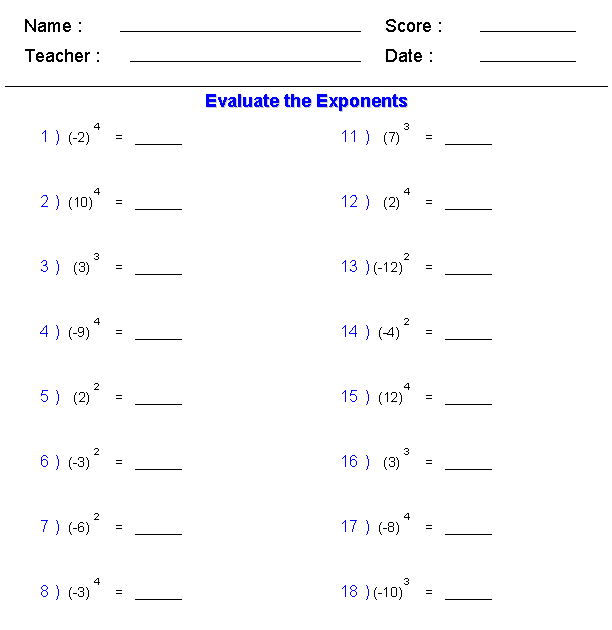

Understanding Exponent Rules
As students enter 8th grade, they are introduced to a new set of math concepts, including exponent rules. These rules are crucial in simplifying expressions and solving equations. In this article, we will delve into the world of exponent rules, exploring the different types and how to apply them. From the product of powers to the power of a power, we will cover it all, providing you with a solid foundation in 8th grade math.
The first step in mastering exponent rules is to understand the basics. The product of powers rule states that when multiplying two powers with the same base, you add the exponents. For example, 2^3 * 2^4 = 2^(3+4) = 2^7. This rule can be applied to any base, making it a versatile tool in simplifying expressions. Another important rule is the power of a power, which states that when raising a power to another power, you multiply the exponents. For instance, (2^3)^4 = 2^(3*4) = 2^12.
Applying Exponent Rules in Real-World Scenarios
In addition to the product of powers and power of a power rules, there are several other exponent rules that are essential to understand. The power of a product rule states that when raising a product to a power, you raise each factor to that power. For example, (2*3)^4 = 2^4 * 3^4. This rule can be useful in simplifying complex expressions. Furthermore, the rule for a power of a quotient states that when raising a quotient to a power, you raise the numerator and denominator to that power. For instance, (2/3)^4 = 2^4 / 3^4.
Exponent rules are not just limited to the classroom; they have numerous real-world applications. In science, exponents are used to describe the growth and decay of populations, as well as the behavior of physical systems. In finance, exponents are used to calculate compound interest and model economic growth. By mastering exponent rules, you will be better equipped to tackle these real-world problems and develop a deeper understanding of the world around you. With practice and patience, you can become proficient in applying exponent rules and take your math skills to the next level.