
Mastering Fractions: Adding Mixed Numbers Made Easy

Understanding Mixed Numbers
Adding mixed numbers can seem like a daunting task, but with the right approach, it can be a breeze. Mixed numbers are a combination of a whole number and a fraction, and they are commonly used in everyday life. For example, 2 1/2 is a mixed number that represents 2 whole units and 1/2 of another unit. To add mixed numbers, you need to follow a few simple steps.
The first step is to convert the mixed numbers to improper fractions. This can be done by multiplying the whole number by the denominator and then adding the numerator. For example, 2 1/2 can be converted to an improper fraction by multiplying 2 by 2 and then adding 1, which gives us 5/2.
Step-by-Step Guide to Adding Mixed Numbers
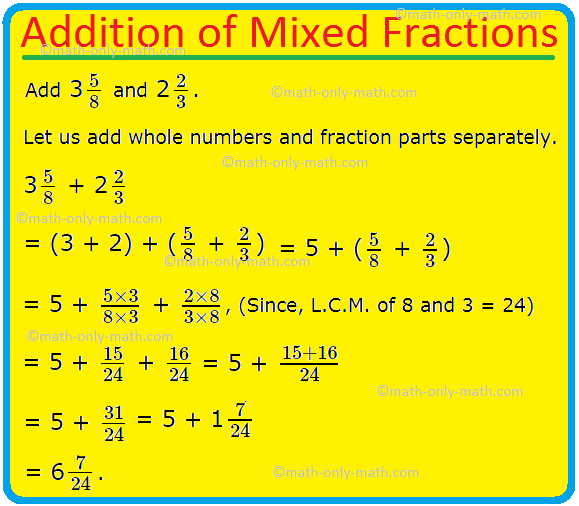
To add mixed numbers, you need to have the same denominator. If the denominators are different, you need to find the least common multiple (LCM) of the two denominators. Once you have the same denominator, you can add the numerators and keep the denominator the same. For example, if you want to add 1 1/2 and 2 1/4, you need to convert them to improper fractions with the same denominator, which is 4 in this case.
Now that you understand the basics of adding mixed numbers, let's go through a step-by-step example. Suppose you want to add 3 1/2 and 2 1/4. First, convert the mixed numbers to improper fractions: 3 1/2 = 7/2 and 2 1/4 = 9/4. Next, find the LCM of 2 and 4, which is 4. Then, convert 7/2 to an improper fraction with a denominator of 4: 7/2 = 14/4. Now you can add the numerators: 14/4 + 9/4 = 23/4. Finally, convert the improper fraction back to a mixed number: 23/4 = 5 3/4. And that's it! With these simple steps, you can add mixed numbers with ease.