Composite Numbers from 1 to 100: A Comprehensive Guide
What are Composite Numbers?
In mathematics, composite numbers are positive integers that have at least one positive divisor other than one or the number itself. In other words, a composite number is any positive integer greater than one that is not a prime number. For instance, 4, 6, 8, 9, and 10 are all composite numbers because they have divisors other than 1 and themselves.
To understand composite numbers better, it's essential to know what prime numbers are. Prime numbers are numbers greater than 1 that have no positive divisors other than 1 and themselves. Examples of prime numbers include 2, 3, 5, 7, and 11. Now, when we look at the range from 1 to 100, we can start identifying which numbers are composite and which are prime.
Counting Composite Numbers from 1 to 100
What are Composite Numbers? Composite numbers are the backbone of many mathematical concepts and are used extensively in various areas of mathematics, such as algebra and number theory. They can be expressed as the product of prime numbers in a unique way, which makes them fascinating to study. For example, the number 12 can be expressed as 2 * 2 * 3, which shows its prime factors.
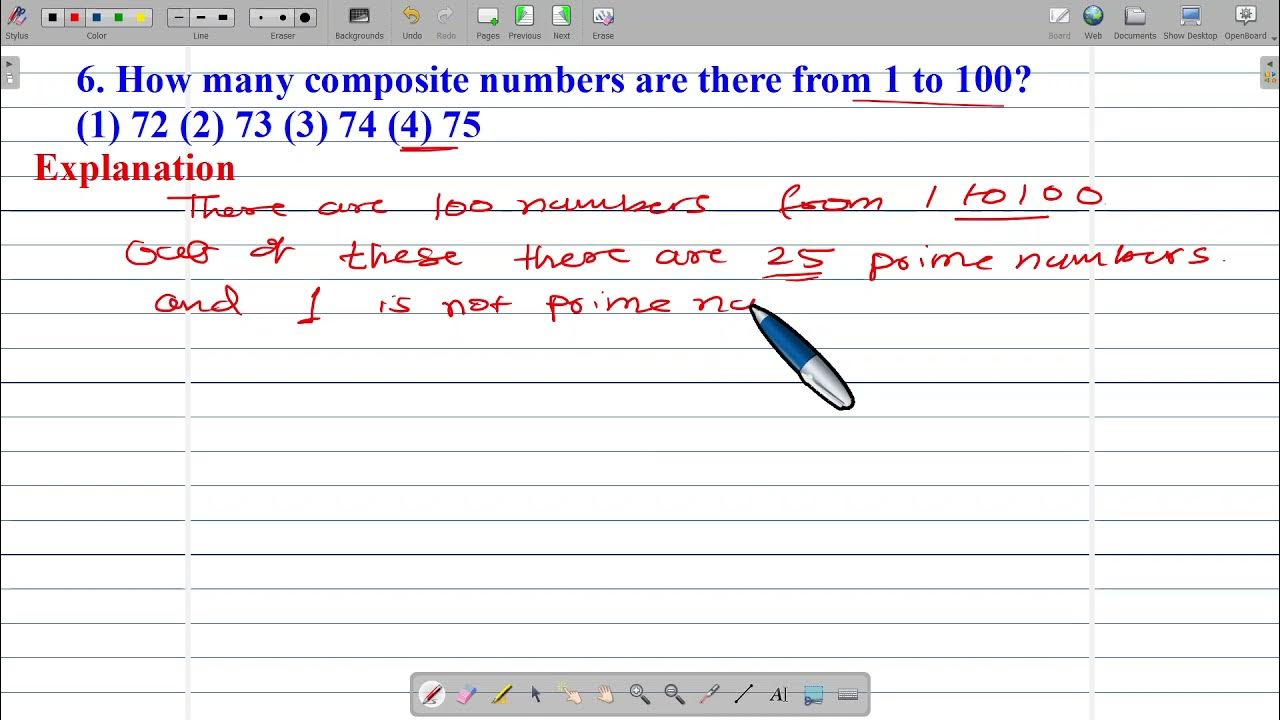
Counting Composite Numbers from 1 to 100 When we count the composite numbers from 1 to 100, we find that there are 74 composite numbers in this range. This is calculated by subtracting the number of prime numbers (25) from the total count of numbers (100) and adjusting for the number 1, which is neither prime nor composite. Understanding composite numbers and their distribution can help us appreciate the beauty and complexity of mathematics.